ABS ALUMNI OF THE MONTH
Question 1:
How does it feel on connecting with your alma mater after a gap of around eight years?
Answer:
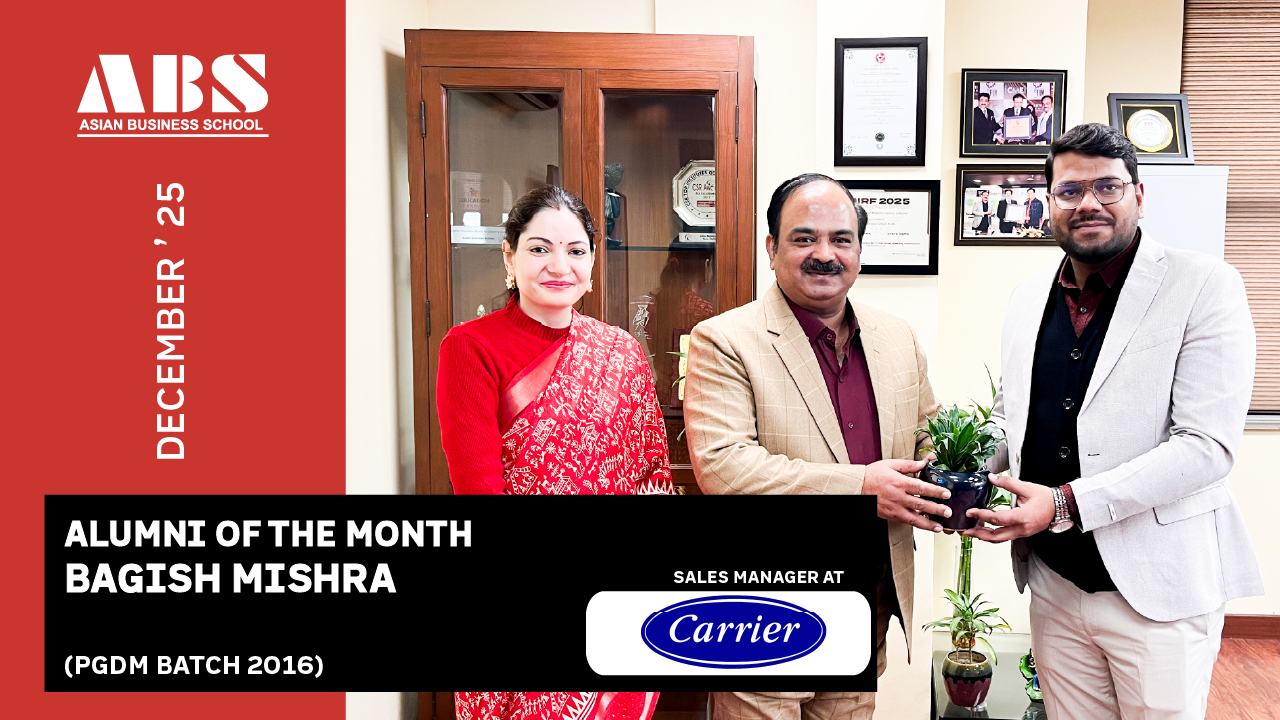
To be honest, it is a very emotional moment for me. I am feeling extremely overwhelmed as I meet the Dean Ma’am, my faculty members, and the juniors. I came to this college with many areas that needed improvement, and trust me, this place has reshaped me entirely. On critical skills like communication, I struggled a lot, but with the help of mentors, I gradually overcame my limitations. I will always feel grateful for this institution.
Question 2:
Looking back, which habit you built during college helped you most in the corporate world?
Answer:
The most important thing is to correct your mindset. People unfortunately undermine the power of mindset—what you achieve and how you use it positively only comes with the right perspective. Second is the power of relations; start developing your network now, because your batchmates today may hold important positions at large MNCs tomorrow. Thirdly, ethics and morality. You may land a good job, but to survive and grow, it is vital to stick to basic moral and ethical values.
Question 3:
You’ve worked with global organizations like Honeywell, Atos, Hochiki and now at Carrier Fire & Security—what skills helped you grow consistently across roles?
Answer:
I started my career with Ceasefire, a placement offered by the college. At present, I am heading the entire North India region for Carrier Fire and Security in the life-saving equipment product line. Leading a team of four, I’ve found that consistent growth comes from the foundation of sales excellence and technical understanding that I began building right from my first role.
Question 4:
Early in your career, what was the toughest “rejection” moment, and how did it shape your mindset in sales and leadership?
Answer:
For Honeywell, I underwent twelve rounds of interviews. After the final round lasted over an hour and a half, I was told to leave. While sitting in the corridor, I was suddenly asked to go back in. The interviewer grilled me for another forty minutes, asking if I was confident I could do the job. I replied, “If there is only one person meant for this job, it is me.” That moment taught me how to turn a potential rejection into a selection through pure confidence.
Question 5:
Sales and business development are often misunderstood—what is the most overlooked reality of this career path that students should know?
Answer:
They are two sides of the same coin. Business development is an indirect approach where you mature opportunities by meeting consultants, architects, and integrators. Sales is the direct approach—speaking to clients, providing quotations, and delivering orders. It’s all part of a cluster; if any function like marketing, finance, or supply chain doesn't work properly, the entire system takes a hit.
Question 6:
What should students start doing now to prepare for global, technology-driven business roles?
Answer:
Technology is impacting every sector, including manufacturing and robotics. However, this transition can be managed if you stay updated. Even experienced professionals cannot take this shift casually. By prioritizing continuous learning and staying knowledgeable about technological developments, you can effectively prepare yourself to survive and thrive in a digital-first economy.
RAPID FIRE QUESTIONS
- If success had one ingredient, what would it be? Excellence
- Coffee or deadlines—what drives you more? Deadlines
- One meeting rule every fresher should follow? Manage by command, not control
- Presentation or viva—which prepares you better? Presentation
- One sign of a healthy organization? Well-structured
- One leadership trait you’re still learning? Pursuance


