23 Jun 2026
AICTE
ApprovedNBA
AccreditedTop Placement
RecordsTrusted by
10k+ AlumniIndustry Expert
FacultyA PGDM in Operations Management provides blend of analytical, technical, and managerial expertise, enabling them to effectively run business operations, streamline supply chains, and optimize production processes. The course covers all aspects of operations management and highlights the latest trends and technologies in the Operations field, ensuring students stay up-to-date with industry developments. The curriculum equips graduates for leadership roles in various sectors like manufacturing, services, retail, logistics, and healthcare, offering a strong foundation in operations management applicable to various sectors.
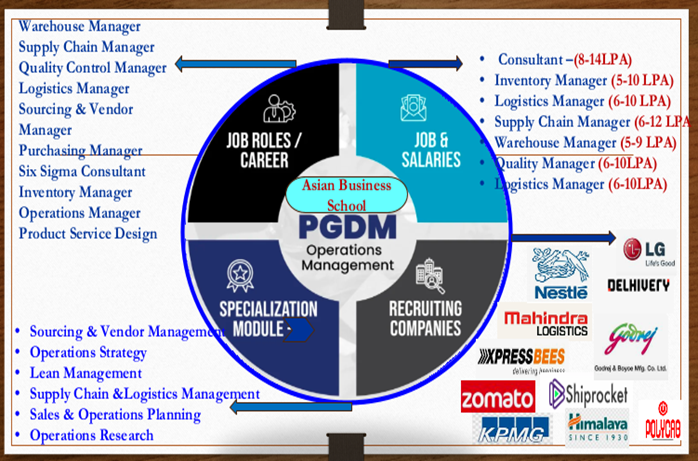
The Course curriculum covers one common subject in First Year and Six Operations specialization subjects in second year as mentioned in Table 1
| Sr. No. | Name of Course (Operations Management Specialization) | Course Credits | PGDM Year |
|---|---|---|---|
| 1 | Production & Operations Management | 3 | First Year |
| 2 | Supply Chain & Logistics Management | 3 | Second Year Specialization |
| 3 | Lean Management | 3 | Second Year Specialization |
| 4 | Sales and Operations Planning | 3 | Second Year Specialization |
| 5 | Operation Research | 3 | Second Year Specialization |
| 6 | Operations Strategy | 3 | Second Year Specialization |
| 7 | Sourcing & Vendor Management | 3 | Second Year Specialization |
| S.No. | Skill Area |
|---|---|
| CORE OPERATIONAL SKILLS | |
| a) | Global Supply Chain Management: Gaining a holistic understanding of the flow of goods and services from procurement to final delivery, complexities of international logistics. |
| b) | Production and Operations Management: Proficiency in planning, organizing, and controlling production activities to enhance operational efficiency. |
| c) | Inventory Management: To maintain optimum inventory levels while reducing inventory cost by application of quantitative techniques. |
| d) | Lean Management Tools: Implementation of continuous improvement methodologies such as Six Sigma, TPM (Total Productive Maintenance) Total Quality Management (TQM), Kanban, 5S and Kaizen. |
| e) | Operation Research and Decision Making: Utilization of mathematical models and analytical frameworks to support data-driven decision-making and process optimization. |
| f) | Data Analytics and Forecasting: Application of statistical tools for demand forecasting, trend analysis, and operational performance measurement. |
| g) | Automation and Industry 4.0 Technologies: Understanding the role of advanced technologies including the Internet of Things (IoT), Artificial Intelligence (AI), and robotics in digital transformation. |
Ans. After PGDM in Operations, students can pursue roles such as Production Operations Manager, Logistics Manager, Supply Chain Executive, Procurement Manager, Vendor Manager, Quality Control Specialist, Warehouse Manager, Lean Consultant, or Data Analytics Professional.
Ans. The main goal is to develop students expertise in planning, controlling, and improving business operations, enabling them to enhance efficiency, streamline processes, and make informed operational decisions.
Ans. Salary prospects vary depending on industry, role, and experience. Entry-level positions such as Operations Executive, Logistics Coordinator, or Procurement Analyst may offer competitive packages starting from 6 -9LPA, while managerial roles like Operations Manager or Supply Chain Manager often command higher salaries starting from 11LPA.
Ans. It holds significant relevance in the current business, where optimizing operations, streamlining supply chains, and leveraging process automation are essential for organizational efficiency. The program provides students with a balanced mix of technical expertise and managerial skills, preparing them to contribute effectively across various industries such as manufacturing, logistics, retail, e-commerce, consulting, and technology-driven sectors.

Explore more ABS blog articles from the current insights library.