ABS ALUMNI OF THE MONTH
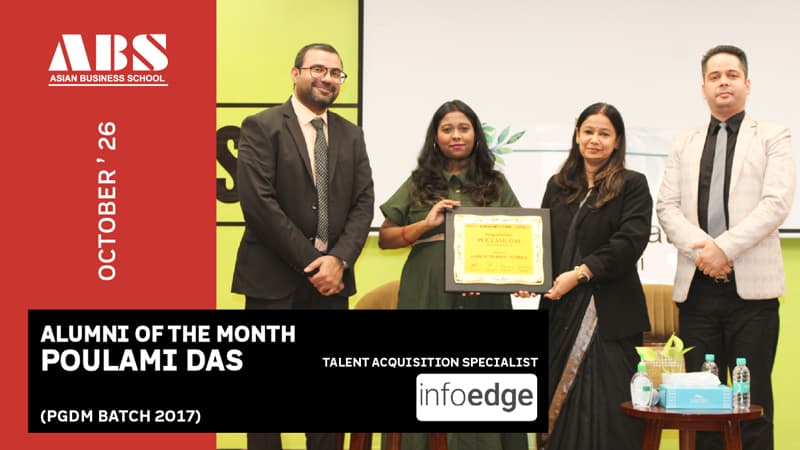
1. You did your PGDM at ABS with a dual specialisation in HR and Marketing. What made you finally choose HR as your career, and how has the marketing side helped you as a recruiter?
Marketing is relevant across every function, whether HR, Sales, Finance, or any other specialization. I chose HR because it aligned more closely with my people-management skills.
One of my strongest memories from ABS is attending Dr. Veenu Arora's marketing classes. The activities and discussions she encouraged helped me develop my brainstorming and creative thinking abilities, which continue to support me as a recruiter. During the COVID period, for example, I conceptualized and launched a Corporate Masterclass Series featuring experienced professionals, managing everything from ideation to implementation.
2. Your projects included a study of Amul's marketing mix compared with its competitors, and a survey on Tetley Tea in India vs the UK that you presented at Oxford College, London. What did those projects teach you that you still use at work?
Those experiences taught me how to create quick, crisp, and impactful presentations. They also gave me the confidence to present ideas before larger audiences, a skill that remains invaluable in my professional life.
3. Your 6-month internship was in the HR team at Intertek India. What were your major learnings from this phase?
The internship taught me the importance of teamwork, stakeholder management, and working effectively within structured timelines and schedules.
4. If you could go back to your first year at ABS, what would you tell yourself, and what's one thing you wish you'd done more of on campus?
I would tell myself to be more present on campus. Since I chose to pursue a winter internship during those months, I missed out on some campus experiences. Looking back, I would have liked to spend more time engaging with campus life.
5. You started at Edventus, where your guiding line was “Not the best candidate, but the most relevant candidate.” What does that mean in practice, and when did you first learn it?
Finding similarities is easy; finding relevance is the real challenge. Recruitment isn't just about matching keywords from a job description. Five candidates may have similar experience, skills, and salary expectations, but identifying the person who best fits the product, service, and organizational culture is what truly creates value.
6. At Edventus you hired across BFSI, fintech, e-commerce, logistics, start-ups and more. How did working with so many industries early on shape you?
Working across diverse industries accelerates learning, improves adaptability, and strengthens multitasking abilities. It also teaches you how to thrive in constantly changing environments. I strongly encourage young professionals to spend at least one or two years with a consulting or management advisory firm, regardless of its size, because the exposure is invaluable.
7. You've moved up from Senior Executive to Volume Hiring (Campus & Lateral) to your current role in Corporate Function hiring. What changed in your skills and mindset at each step?
One thing remained constant throughout my journey: candidate experience.
What evolved was my understanding of talent pools, role positioning, headhunting strategies, stakeholder expectations, and negotiation skills. As the complexity of hiring increased, the approach became more strategic and nuanced.
8. You've run high-volume hiring drives, such as Info Edge's Jaipur drive for 99acres. What goes on behind the scenes of a hiring drive that students never see?
A hiring drive is often the result of an entire week's preparation. It involves promoting the walk-in event, identifying the right talent pool, sending reminders, optimizing job postings across multiple platforms, and coordinating with administrative teams to ensure candidates have a smooth and comfortable experience throughout the process.
9. You're now the person on the other side of the campus placement table. What makes a fresher stand out to you, and what are the most common mistakes students make in interviews?
One of the most common mistakes students make is not researching the company thoroughly. Understanding the organization's products, services, and business model can help you succeed in nearly half the interview discussion.
Freshers are expected to be nervous, but what recruiters look for most is:
- Confidence to take ownership of responsibilities.
- An eagerness to learn and grow.
Candidates who demonstrate these qualities naturally stand out.
10. You also look after Central TA Analytics. How is data changing recruitment, and how are AI tools changing the way candidates are screened today?
Data enables better hiring decisions by improving visibility into timelines, talent availability, compensation structures, and stakeholder requirements.
AI is no longer just a tool; it's becoming an essential skill. Professionals must learn to work alongside it to remain relevant in a rapidly changing economy. Since AI is built on data and knowledge, the stronger our own knowledge base, the more effectively we can leverage AI rather than compete with it.
11. For close to three years you did freelance creative writing and soft-skills training alongside your full-time job. How did you manage both, and what did the writing give you that recruitment didn't?
Writing has always been my passion. I typically took on fortnightly assignments during weekends or extended breaks. It gave me a refreshing change from my recruitment work while also providing an additional source of income. Most importantly, it allowed me to pursue something I genuinely enjoyed.
12. Your LinkedIn opens with “You are not good enough if your job is the only thing you do.” What does that line mean to you, and how do you live it?
A routine centered entirely around work can become monotonous. It's important to have hobbies, interests, sports, or activities outside of your profession that keep your energy levels high and your perspective fresh. Those experiences contribute significantly to personal growth and confidence.
13. You've arranged pro-bono mentoring and corporate masterclasses that connected B-school freshers with experienced professionals. Why does giving back matter to you, the “Get and Give” idea you write about?
Sharing even a small portion of your experiences with others helps you:
- Recognize how far you've come.
- Reinforce and revisit your own learning.
- Understand the value of your knowledge.
- Help newcomers navigate their careers more effectively.
- Open doors to new opportunities.
- Create a positive cycle of learning and contribution.
14. What one piece of advice would you give current ABS students, especially those choosing HR as a specialization, to be ready for the industry on day one?
Focus first on entering the HR profession. The market is dynamic, and strategic HR roles are rarely available to freshers. Accept opportunities, learn the fundamentals, prove your capabilities, and continue building expertise. Growth comes steadily as you climb the ladder.
Rapid-fire questions
- Naukri or LinkedIn? Naukri
- Best interview answer you've ever heard, in one line? "I have always been in roles that required implementing business decisions. Now, I am looking for an opportunity where I can actively contribute to shaping those decisions."
- One word that describes your days at ABS? Experimental
- Your favourite spot on campus? Cafeteria
- Your biggest red flag in a résumé? Spelling mistakes
- One skill every fresher must have? Eagerness to learn
- A book or podcast you'd recommend? Abhi and Niyu (Podcast)
- Finish the sentence: “ABS taught me...” "...introspect, understand my strengths, and make decisions that align with my skills."


